

PostgreSQL 数据库内核分析-c3
-
date_range 01/01/2021 00:00
点击量:次infosortPostgreSQLlabelPostgreSQL数据库存储书籍
3. 第3章 存储管理
3.1. 存储管理器的体系结构
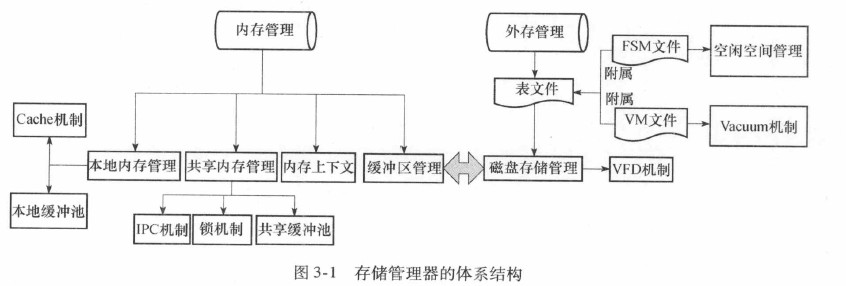
PG提供了轻量级锁,用于支持对共享内存中同一数据的互斥访问。
存储管理器的主要任务:
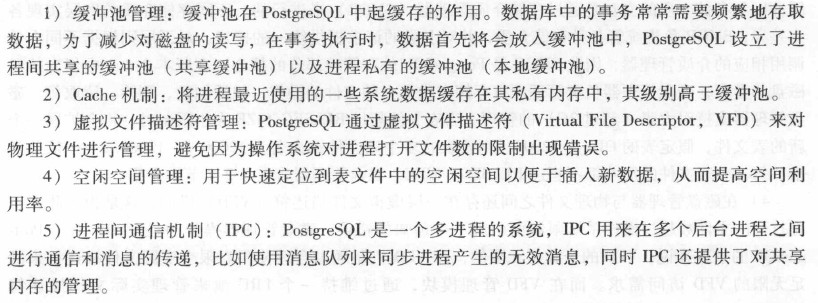

以读写元组的过程为例, 说明各个模块的使用顺序:
- 设置
cache来存储系统表元组和表的基本信息; - 首先从共享缓冲池查找所需文件对应的缓冲块
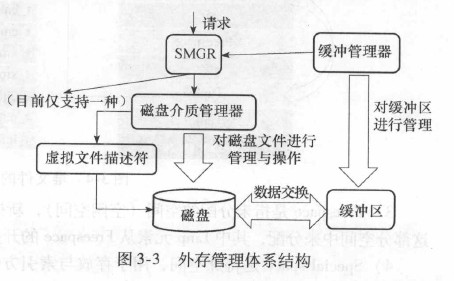
- 缓冲区和存储介质的交互式通过存储介质管理器
SMGR来进行的,这是外存管理的核心 - 在磁盘管理器与物理文件之间还存在一层虚拟文件描述符
VFD机制,防止进程打开的文件数超过操作系统限制,通过合理使用有限个实际文件描述符来满足无限的VFD访问需求。 - 在写入元组的时候,需要使用一定策略找到一个具有合适空闲空间的缓冲块,然后将该元组装填到缓冲块中。系统会在适当的时候将这些被写入数据的缓冲块刷回到存储介质中。
- 删除元组: 在元组上作删除标记,物理清除工作由
VACUUM策略来完成。
3.2. 外存管理
外存管理体系结构:
3.2.1. 表和元组的组织方式
堆文件的概念: 同一个表中的元组按照创建顺序依次插入到表文件中,元组之间不进行关联,这样的表文件称为堆文件。
堆文件的分类:
- 普通堆
- 临时堆 : 会话过程中临时创建,会话结束自动删除
- 序列 : 元组值自动正常的特殊堆
- TOAST表 : 专门用于存储变长数据。
堆文件的物理结构如下:
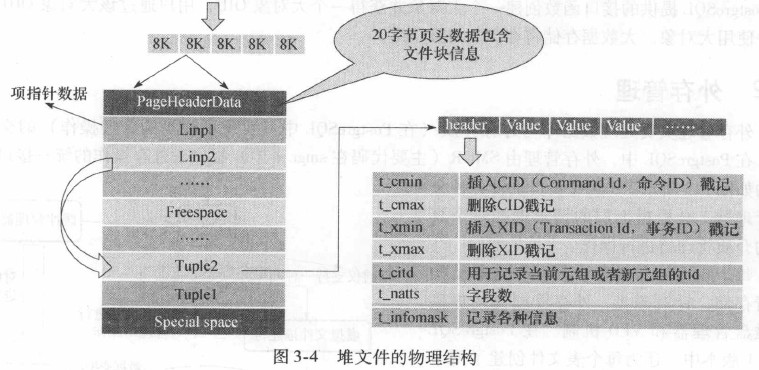
Linp的类型是ItemIdData,如下所示:
typedef struct ItemIdData {
    unsigned lp_off : 15, /* offset to tuple (from start of page) */
        lp_flags : 2,     /* state of item pointer, see below */
        lp_len : 15;      /* byte length of tuple */
} ItemIdData;
使用ItemIdData来指向文件块中的一个元组。元组信息除了存放元组的实际数据,还存放元组头部信息, 通过HeapTupleHeaderData来描述, 在其中包含了删除标记位。
typedef struct HeapTupleHeaderData {
    union {
        // 记录对元组执行操作的事务ID和命令ID, 用于并发控制时检查元组对事务的可见性
        HeapTupleFields t_heap;
        // 记录元组的长度等信息
        DatumTupleFields t_datum;
    } t_choice;

    ItemPointerData t_ctid; /* current TID of this or newer tuple */

    /* Fields below here must match MinimalTupleData! */

    uint16 t_infomask2; /* number of attributes + various flags */

    uint16 t_infomask; /* various flag bits, see below */

    uint8 t_hoff; /* sizeof header incl. bitmap, padding */

    /* ^ - 23 bytes - ^ */

    bits8 t_bits[FLEXIBLE_ARRAY_MEMBER]; /* bitmap of NULLs -- VARIABLE LENGTH */

    /* MORE DATA FOLLOWS AT END OF STRUCT */
} HeapTupleHeaderData;
PostgreSQL中使用了HOT技术, 用于在对元组采用多版本技术存储时占用存储过多的问题, 如果更新操作没有修改索引属性, 就不生成拥有完全相同键值的索引记录。
3.2.2. 磁盘管理器
主要实现在md.c, 通过VFD机制来进行文件操作。
typedef struct _MdfdVec {
    // 该文件对应的`VFD`
    File mdfd_vfd;               /* fd number in fd.c's pool */
    // 这个文件是一个大表文件的第几段
    BlockNumber mdfd_segno;      /* segment number, from 0 */
    struct _MdfdVec *mdfd_chain; /* next segment, or NULL */
} MdfdVec;
3.2.3. VFD机制
绕过操作系统对于文件描述符数量的限制。
3.2.3.1. 实现原理
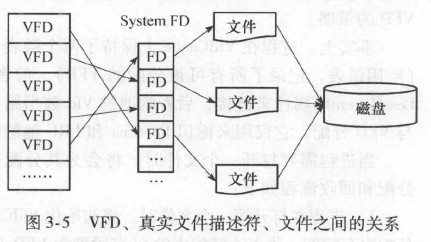
当进程申请打开一个文件时,返回一个虚拟文件描述符,该描述符指的是一个VFD数据结构
一个进程打开的VFD存储在VfdCache中。
typedef struct vfd
{
	int			fd;				/* current FD, or VFD_CLOSED if none */
    // 用于决定在关闭此文件时是要同步修改还是删除该文件
	unsigned short fdstate;		/* bitflags for VFD's state */
	ResourceOwner resowner;		/* owner, for automatic cleanup */
	File		nextFree;		/* link to next free VFD, if in freelist */
    // 指向比该VFD最近更常用的虚拟文件描述符
	File		lruMoreRecently;	/* doubly linked recency-of-use list */
    // 指向比该VFD最近更不常用的虚拟文件描述符
	File		lruLessRecently;
	off_t		seekPos;		/* current logical file position */
	off_t		fileSize;		/* current size of file (0 if not temporary) */
	char	   *fileName;		/* name of file, or NULL for unused VFD */
	/* NB: fileName is malloc'd, and must be free'd when closing the VFD */
	int			fileFlags;		/* open(2) flags for (re)opening the file */
	int			fileMode;		/* mode to pass to open(2) */
} Vfd;
static Vfd *VfdCache;
3.2.3.2. LRU池
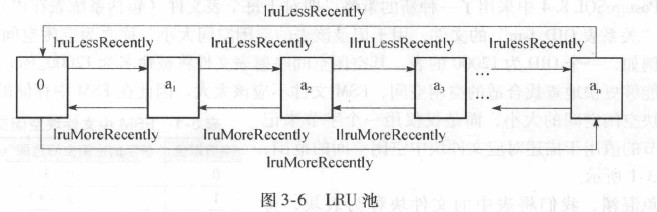
每个进程都是用一个LRU池来管理所有已经打开的VFD, 当LRU池未满时,进程打开的文件个数未超过操作系统限制;当LRU池满时,进程需要首先关闭一个VFD,使用替换最长时间未使用VFD的策略。
LRU池的数据结构如下所示:
3.2.4. 空闲空间映射表
对于每个表文件, 同时创建一个名为关系表OID_fsm的文件,用于记录该表的空闲空间大小, 称之为空闲空间映射表文件FSM。
使用一个字节来记录空闲空间范围大小。
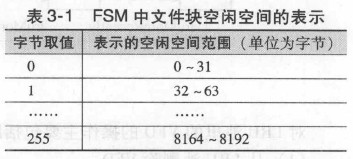
为了实现快速查找, FSM文件使用树结构来存储每个表块的空闲空间,
块之间使用了一个三层树的结构, 第0层和第1层为辅助层,第2层FSM块用于实际存放各表块的空闲空间值。
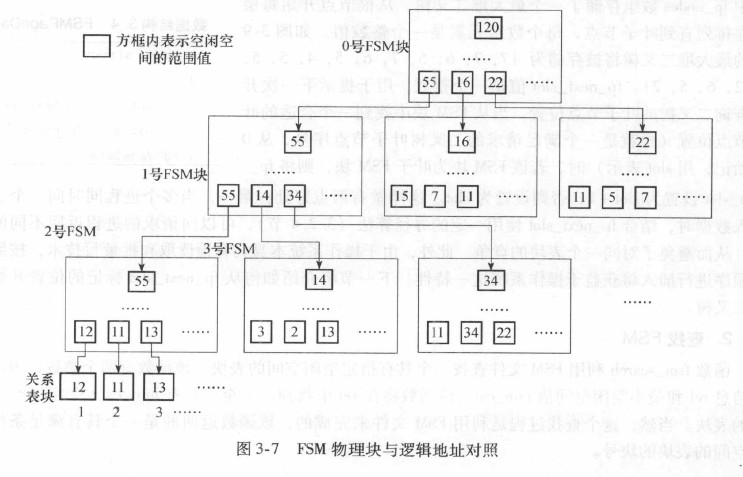
每个FSM块大约可以保存4000个叶子节点, 三层树结构总共可以存储4000^3个叶子节点。

3.2.5. 可见性映射表
为了能够加快VACUUM查找包含无效元组的文件块的过程,在表中为表文件定义了一个新的附属文件——可见性映射表(VM)。
3.2.6. 大数据存储
3.3. 内存管理
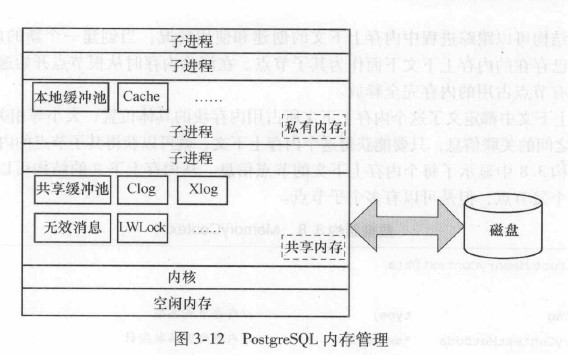
存储管理的本质问题:如何减少IO次数。要尽可能让最近使用的文件块停留在内存中,这样能有效减少磁盘IO代价。
3.3.1. 内存上下文概述
内存上下文用于解决在以指针传值时造成的内存泄漏问题。
系统的内存分配操作在各种语义的内存上下文中进行,所有在内存上下文中分配的内存空间都通过内存上下文进行记录。
一个内存上下文实际上相当于一个进程环境, 进程环境中调用库函数(malloc/free/realloc)执行内存操作, 类似的, 内存上下文使用(palloc/pfree/repalloc)函数进行内存操作。
3.3.1.1 MemoryContext
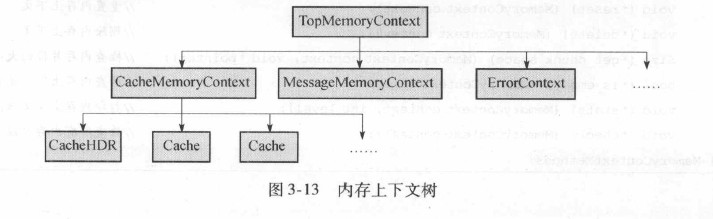
每一个子进程拥有多个私有的内存上下文,每个子进程的内存上下文组成一个树形结构。
typedef struct MemoryContextData
{
	NodeTag		type;			/* identifies exact kind of context */
	MemoryContextMethods *methods;		/* virtual function table */
	MemoryContext parent;		/* NULL if no parent (toplevel context) */
	MemoryContext firstchild;	/* head of linked list of children */
	MemoryContext nextchild;	/* next child of same parent */
	char	   *name;			/* context name (just for debugging) */
	bool		isReset;		/* T = no space alloced since last reset */
} MemoryContextData;

typedef struct MemoryContextMethods {
    // 内存上下文操作的函数指针
    void* (*alloc)(MemoryContext context, Size size);
    /* call this free_p in case someone #define's free() */
    void (*free_p)(MemoryContext context, void* pointer);
    void* (*realloc)(MemoryContext context, void* pointer, Size size);
    void (*init)(MemoryContext context);
    void (*reset)(MemoryContext context);
    void (*delete_context)(MemoryContext context);
    Size (*get_chunk_space)(MemoryContext context, void* pointer);
    bool (*is_empty)(MemoryContext context);
    void (*stats)(MemoryContext context, int level);
#ifdef MEMORY_CONTEXT_CHECKING
    void (*check)(MemoryContext context);
#endif
} MemoryContextMethods;

/*
 * This is the virtual function table for AllocSet contexts.
 */
static MemoryContextMethods AllocSetMethods = {
	AllocSetAlloc,
	AllocSetFree,
	AllocSetRealloc,
	AllocSetInit,
	AllocSetReset,
	AllocSetDelete,
	AllocSetGetChunkSpace,
	AllocSetIsEmpty,
	AllocSetStats
#ifdef MEMORY_CONTEXT_CHECKING
	,AllocSetCheck
#endif
};
MemoryContextMethods方法是对MemoryContext类型的上下文执行的一系列操作。
@startuml
MemoryContext <|-- AllocSetContext
MemoryContextMethods <|-- AllocSetMethods
@enduml
在任何时候,都有一个当前的MemoryContext,其用CurretMemoryContext表示。
通过MemoryContextSwitchTo函数来修改当前上下文。
内存上下文的组织结构如下:
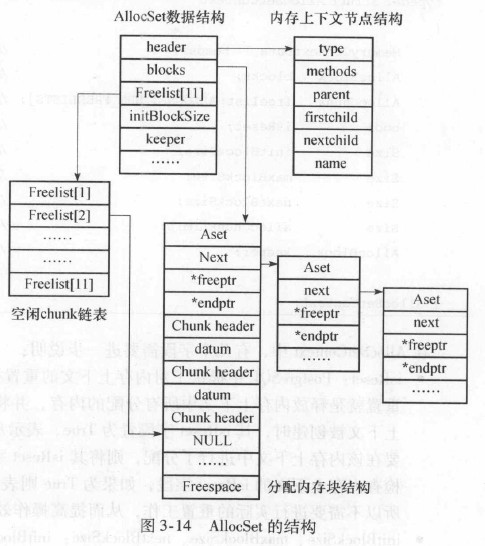
层次结构如下:
- AllocSet
- AllocBlockData
- chunk
- AllocBlockData
参考PostgreSQL内存上下文学习, 内存块(block)和内存片(chunk)的区别如下:
AllocSetContext中有两个数据结构AllocBlock和AllocChunk,分别代表内存块和内存片,PostgreSQL就是使用内存块和内存片来管理具体的内存的。AllocSet所管理的内存区域包含若干个内存块(内存块用AllocBlockData结构表示),每个内存块又被分为多个内存片(用AllocChunkData结构表示)单元。我们一般认为内存块是“大内存”,而内存片是“小内存”,PostgreSQL认为大内存使用频率低,小内存使用频率高。所以申请大内存(内存块)使用的是malloc,并且使用完以后马上会释放给操作系统,而申请小内存(内存片)使用的是自己的一套接口函数,而且使用完以后并没有释放给操作系统,而是放入自己维护的一个内存片管理链表,留给后续使用。
typedef AllocSetContext *AllocSet;
typedef struct AllocSetContext
{
	MemoryContextData header;	/* Standard memory-context fields */
	/* Info about storage allocated in this context: */
	AllocBlock	blocks;			/* head of list of blocks in this set */
	AllocChunk	freelist[ALLOCSET_NUM_FREELISTS];		/* free chunk lists */
	/* Allocation parameters for this context: */
	Size		initBlockSize;	/* initial block size */
	Size		maxBlockSize;	/* maximum block size */
	Size		nextBlockSize;	/* next block size to allocate */
	Size		allocChunkLimit;	/* effective chunk size limit */
	AllocBlock	keeper;			/* if not NULL, keep this block over resets */
} AllocSetContext;

// 内存块使用`AllocBlockData`数据结构表示1
typedef struct AllocBlockData
{
	AllocSet	aset;			/* aset that owns this block */
	AllocBlock	next;			/* next block in aset's blocks list */
	char	   *freeptr;		/* start of free space in this block */
	char	   *endptr;			/* end of space in this block */
}	AllocBlockData;
核心数据结构为AllocSetContext,这个数据结构有3个成员MemoryContextData header;和AllocBlock blocks;和AllocChunk freelist[ALLOCSET_NUM_FREELISTS];。这3个成员把内存管理分为3个层次。
- 第1层是MemoryContext,MemoryContext管理上下文之间的父子关系,设置MemoryContext的内存管理函数。
- 第2层为AllocBlock blocks,把所有内存块通过双链表链接起来。
- 第3层为具体的内存单元chunk,内存单元Chunk是从内存块AllocBlock内部分配的,内存块和内存单元chunk的转换关系为:AllocChunk chunk = (AllocChunk)(((char)block) + ALLOC_BLOCKHDRSZ);和AllocBlock block = (AllocBlock)(((char)chunk) - ALLOC_BLOCKHDRSZ);。 内存单元chunk经过转换得到最终的用户指针,内存单元chunk和用户指针的转换关系为:((AllocPointer)(((char)(chk)) + ALLOC_CHUNKHDRSZ))和((AllocChunk)(((char)(ptr)) - ALLOC_CHUNKHDRSZ))。
3.3.1.2 内存上下文初始化与创建
由函数MemoryContextInit完成。
先创建根节点TopMemoryContext, 然后在该节点下创建子节点ErrorContext用于错误恢复处理。
内存上下文的创建由AllocSetContextCreate实现:
- 创建内存上下文节点:
MemoryContextCreate- 从
TopMemoryContext节点中分配一块内存用于存放内存上下文节点 - 初始化
MemoryContext节点context = (AllocSet)MemoryContextCreate(type, sizeof(AllocSetContext), parent, name, __FILE__, __LINE__);
- 从
- 分配内存块
- 填充
context结构体 根据最大块大小maxBlockSize来设置allocChunkLimit的值,在这里allocChunkLimit的决定函数是f(ALLOC_CHUNK_LIMIT, ALLOC_CHUNKHDRSZ, ALLOC_BLOCKHDRSZ, ALLOC_CHUNK_FRACTION, maxBlockSize)。 - 如果
minContextSize > ALLOC_BLOCKHDRSZ + ALLOC_CHUNKHDRSZ,调用标准库函数分配内存块, 预分配的内存块将计入到内存上下文的keeper字段中, 作为内存上下文的保留快, 以便重置内存上下文的时候, 该内存块不会被释放。
- 填充
完成上下文创建之后, 可以在该内存上下文进行内存分配, 通过MemoryContextAlloc和MemoryContextAllocZero两个接口函数来完成。
3.3.1.3 内存上下文中内存的分配
参考: PostgreSQL内存上下文
| 函数 | 功能 |
|---|---|
| MemoryContextCreate | 创建上下文节点 |
| AllocSetContextCreate | 创建上下文实例 |
| MemoryContextDelete | 删除内存上下文 |
| MemoryContextReset | 重置内存上下文 |
| MemoryContextSwitchTo | 切换当前上下文 |
| palloc | 在当前上下文中申请内存, 调用了当前内存上下文的methods字段中指定的alloc函数,调用了AllocSetAlloc |
| pfree | 释放内存, 调用了当前内存上下文的methods字段中指定的free_p函数 |
| repalloc | 在当前上下文中重新申请内存, 调用了当前内存上下文的methods字段中指定的ralloc函数 |
3.3.1.4 内存上下文中的内存重分配
3.3.1.5 释放内存上下文
3.3.2. 高速缓存
设立高速缓存提高访问效率,用于存放系统表元组(SysCache)和表模式信息(RelCache)。
RelCache中存放的是RelationData数据结构。
3.3.2.1 SysCache
系统表数据结构:
typedef struct catcache
{
	int			id;				/* cache identifier --- see syscache.h */
	struct catcache *cc_next;	/* link to next catcache */
	const char *cc_relname;		/* name of relation the tuples come from */
	Oid			cc_reloid;		/* OID of relation the tuples come from */
	Oid			cc_indexoid;	/* OID of index matching cache keys */
	bool		cc_relisshared; /* is relation shared across databases? */
	TupleDesc	cc_tupdesc;		/* tuple descriptor (copied from reldesc) */
	int			cc_ntup;		/* # of tuples currently in this cache */
	int			cc_nbuckets;	/* # of hash buckets in this cache */
	int			cc_nkeys;		/* # of keys (1..CATCACHE_MAXKEYS) */
	int			cc_key[CATCACHE_MAXKEYS];		/* AttrNumber of each key */
	PGFunction	cc_hashfunc[CATCACHE_MAXKEYS];	/* hash function for each key */
	ScanKeyData cc_skey[CATCACHE_MAXKEYS];		/* precomputed key info for
												 * heap scans */
	bool		cc_isname[CATCACHE_MAXKEYS];	/* flag "name" key columns */
	Dllist		cc_lists;		/* list of CatCList structs */
#ifdef CATCACHE_STATS
	long		cc_searches;	/* total # searches against this cache */
	long		cc_hits;		/* # of matches against existing entry */
	long		cc_neg_hits;	/* # of matches against negative entry */
	long		cc_newloads;	/* # of successful loads of new entry */

	/*
	 * cc_searches - (cc_hits + cc_neg_hits + cc_newloads) is number of failed
	 * searches, each of which will result in loading a negative entry
	 */
	long		cc_invals;		/* # of entries invalidated from cache */
	long		cc_lsearches;	/* total # list-searches */
	long		cc_lhits;		/* # of matches against existing lists */
#endif
	Dllist		cc_bucket[1];	/* hash buckets --- VARIABLE LENGTH ARRAY */
} CatCache;						/* VARIABLE LENGTH STRUCT */
系统表的数据结构是一个以CatCache为元素的数组
static CatCache *SysCache[
						  lengthof(cacheinfo)];
static int	SysCacheSize = lengthof(cacheinfo);
static const struct cachedesc cacheinfo[] = {
	{AggregateRelationId,		/* AGGFNOID */
		AggregateFnoidIndexId,
		1,
		{
			Anum_pg_aggregate_aggfnoid,
			0,
			0,
			0
		},
		32
	}
}
cachedesc结构如下所示:
struct cachedesc
{
	Oid			reloid;			/* OID of the relation being cached */
	Oid			indoid;			/* OID of index relation for this cache */
	int			nkeys;			/* # of keys needed for cache lookup */
	int			key[4];			/* attribute numbers of key attrs */
	int			nbuckets;		/* number of hash buckets for this cache */
};
3.3.2.1.1 SysCache 初始化
SysCache的初始化过程:
- InitCatalogCache
- 循环调用
InitCatCache根据cacheinfo中的每一个元素生成CatCache结构- 分配内存
- 填充字段
- 循环调用
- InitCatalogCachePhase2
- 依次完善
SysCache数组中的CatCache结构- 根据对应的系统表填充
CatCache结构中的成员。
- 根据对应的系统表填充
- 依次完善
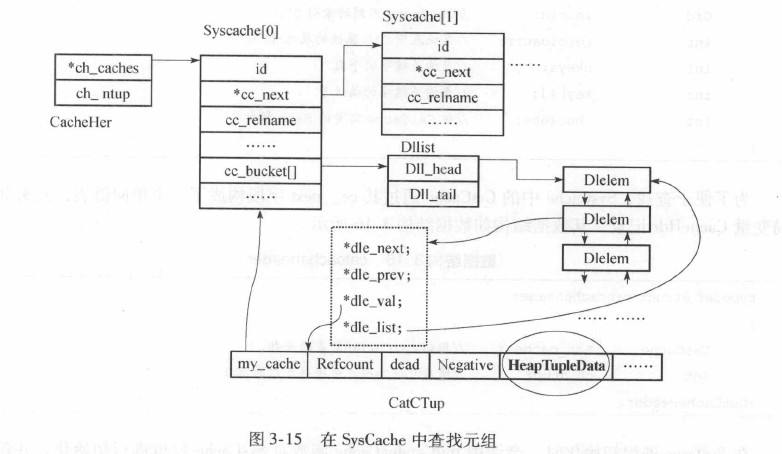
3.3.2.1.2 CatCache 中缓存元组的组织
对应结构:
3.3.2.1.3 在 CatCache 中查找元组
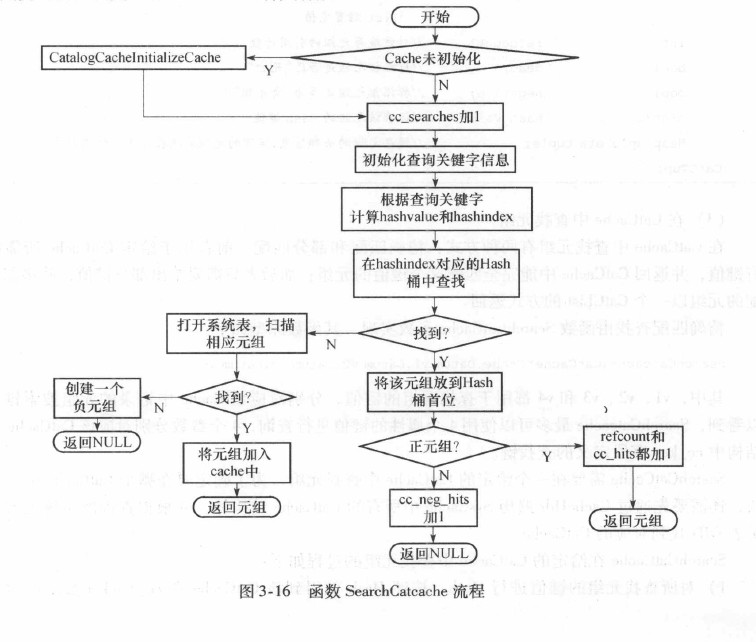
SearchCatCache的作用: 在一个给定的CatCache中查找元组。
主要流程:
3.3.2.2 RelCache
RelCache的初始化RelCache的插入RelCache的查询RelCache的删除
3.3.2.3 Cache同步
每个进程都有属于自己的Cache, 当某个Cache中的一个元组被删除或更新时,需要通知其他进程对其Cache进行同步。PG会记录下已经被删除的无效元组,并通过SI Message方式(共享消息队列方式)在进程之间传递这一消息。
SI Message的数据结构如下所示:
typedef union
{
	int8		id;				/* type field --- must be first */
	SharedInvalCatcacheMsg cc;
	SharedInvalCatalogMsg cat;
	SharedInvalRelcacheMsg rc;
	SharedInvalSmgrMsg sm;
	SharedInvalRelmapMsg rm;
} SharedInvalidationMessage;
三种无效消息:
SysCache中元组无效RelCache中元组无效SMGR无效(关闭表文件)
进程通过调用函数CacheInvalidateHeapTuple对无效消息进行注册。
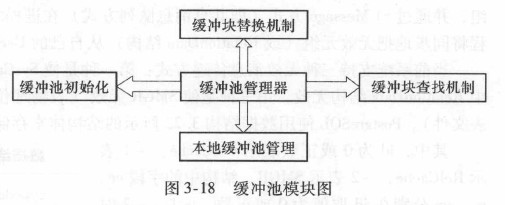
3.3.3. 缓冲池管理
如果需要访问的系统表元组在Cache中无法找到或者需要访问普通表的元组,就需要对缓冲池进行访。
需要访问的数据以 磁盘块 为单位调用函数smgrread写入缓冲池, smgrwrite将缓冲池数据写回到磁盘。 调入缓冲池中的磁盘块称为缓冲区、缓冲块或者页面, 多个缓冲区组成了缓冲池。
对共享缓冲区的管理采取了静态方式:在系统配置时规定好了共享缓冲区的总数
int NBuffers = 64;
我的小问题: 当前系统的
NBuffers是多少?
通过追踪对应的数据结构,
knl_instance_context g_instance;

knl_instance_context {
    knl_instance_attr_t attr;
}

typedef struct knl_instance_attr {

    knl_instance_attr_sql attr_sql;
    knl_instance_attr_storage attr_storage;
    knl_instance_attr_security attr_security;
    knl_instance_attr_network attr_network;
    knl_instance_attr_memory attr_memory;
    knl_instance_attr_resource attr_resource;
    knl_instance_attr_common attr_common;

} knl_instance_attr_t;

typedef struct knl_instance_attr_storage {
    int NBuffers;
}
答案是
p g_instance.attr.attr_storage.NBuffers

4096
分类:
- 共享缓冲池: 要用作普通可共享表的操作场所
- 本地缓冲池: 仅本地可见的临时表的操作场所
对缓冲池的管理通过pin机制和lock机制完成。
pin是缓冲区的访问计数器, 保存在缓冲区的refcount属性typedef struct sbufdesc { BufferTag tag; /* ID of page contained in buffer */ BufFlags flags; /* see bit definitions above */ uint16 usage_count; /* usage counter for clock sweep code */ unsigned refcount; /* # of backends holding pins on buffer */ int wait_backend_pid; /* backend PID of pin-count waiter */ slock_t buf_hdr_lock; /* protects the above fields */ int buf_id; /* buffer's index number (from 0) */ int freeNext; /* link in freelist chain */ LWLockId io_in_progress_lock; /* to wait for I/O to complete */ LWLockId content_lock; /* to lock access to buffer contents */ } BufferDesc;lock机制为缓冲区的并发访问提供了EXCLUSIVE锁和SHARE锁
3.3.3.1 初始化共享缓冲池
InitBufferPool函数: 在共享缓冲区管理中, 使用了全局数组BufferDescriptors来管理池中的缓冲区。
#define GetBufferDescriptor(id) (&t_thrd.storage_cxt.BufferDescriptors[(id)].bufferdesc)

typedef struct knl_t_storage_context {
    /*
     * Bookkeeping for tracking emulated transactions in recovery
     */
    TransactionId latestObservedXid;
    struct RunningTransactionsData* CurrentRunningXacts;
    struct VirtualTransactionId* proc_vxids;

    union BufferDescPadded* BufferDescriptors;
    // 存储缓冲池的起始地址
    char* BufferBlocks;
}

// 对缓冲区进行描述
typedef struct BufferDesc {
    BufferTag tag; /* ID of page contained in buffer */
    /* state of the tag, containing flags, refcount and usagecount */
    pg_atomic_uint32 state;

    int buf_id;    /* buffer's index number (from 0) */

    ThreadId wait_backend_pid; /* backend PID of pin-count waiter */

    LWLock* io_in_progress_lock; /* to wait for I/O to complete */
    LWLock* content_lock;        /* to lock access to buffer contents */

    /* below fields are used for incremental checkpoint */
    pg_atomic_uint64 rec_lsn;        /* recovery LSN */
    volatile uint64 dirty_queue_loc; /* actual loc of dirty page queue */
} BufferDesc;
数组元素的个数是缓冲区的总数, BufferDescriptors就是共享缓冲池。
缓冲区初始化流程:
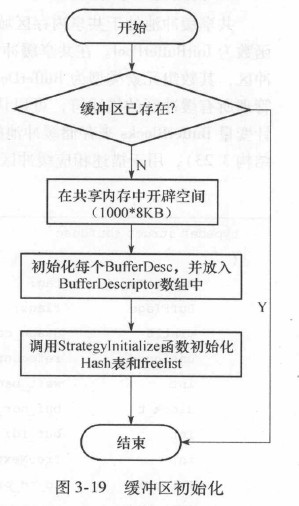
- 在共享内存中开辟内存
InitBufferPool初始化缓冲区描述符, 建立Hash表和FreeList结构ShmemInitHash初始化缓冲区Hash表
3.3.3.2 共享缓冲区查询
查询时, 以BufferTag作为索引键,查找Hash表并返回目标缓冲区在缓冲区描述符数组中的位置。
typedef struct buftag
{
	RelFileNode rnode;			/* physical relation identifier */
	ForkNumber	forkNum;
	BlockNumber blockNum;		/* blknum relative to begin of reln */
} BufferTag;
缓冲区读取流程
Buffer ReadBuffer(Relation reln, BlockNumber block_num)
{
    return ReadBufferExtended(reln, MAIN_FORKNUM, block_num, RBM_NORMAL, NULL);
        buf = ReadBuffer_common(reln->rd_smgr, reln->rd_rel->relpersistence, fork_num, block_num, mode, strategy, &hit);
            // 执行缓冲区替换策略
            bufHdr = BufferAlloc(smgr, relpersistence, forkNum, blockNum, strategy, &found);
}
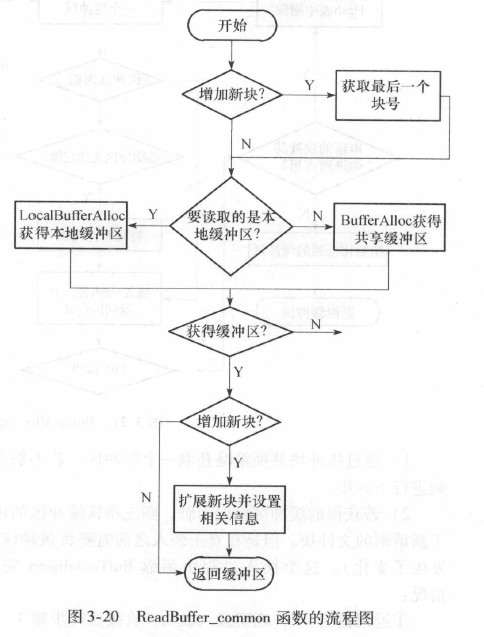
ReadBuffer_common函数是所有缓冲区读取的通用函数, 其流程:
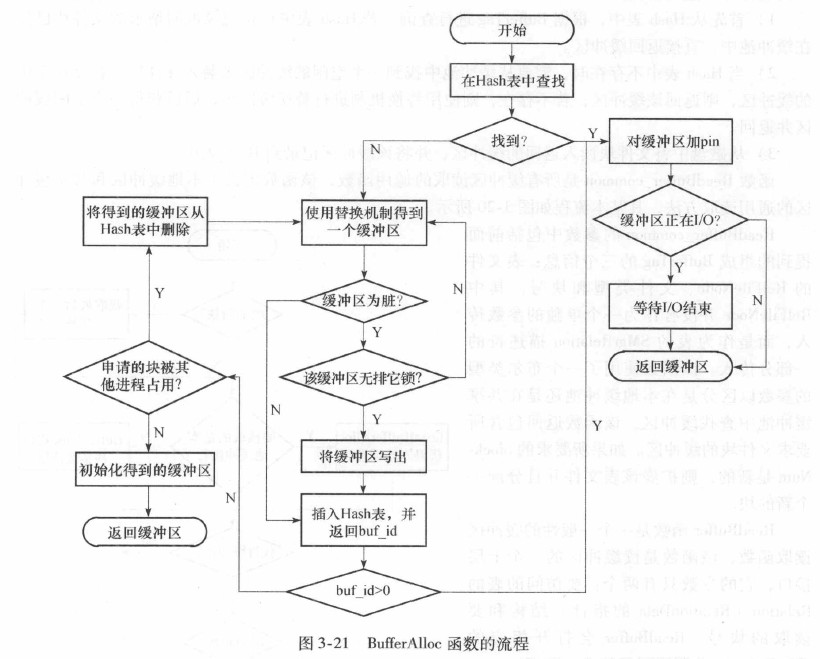
BufferAlloc函数用于获得指定的共享缓冲区, 其流程:
3.3.3.3 共享缓冲区替换策略
3.3.3.3.1 一般的缓冲区替换策略
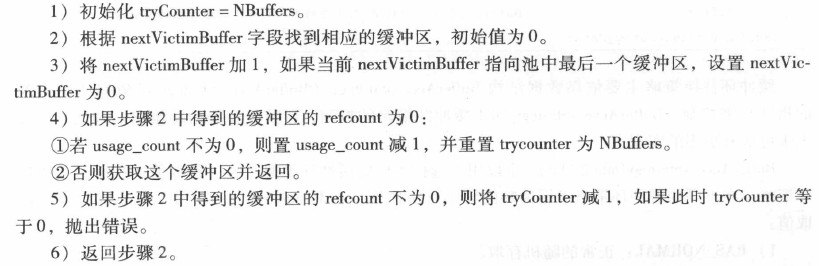
在缓冲区中维护一个FreeList, BufferStrategyControl结构用于对FreeList进行控制。
typedef struct
{
	/* Clock sweep hand: index of next buffer to consider grabbing */
	int			nextVictimBuffer;

	int			firstFreeBuffer;	/* Head of list of unused buffers */
	int			lastFreeBuffer; /* Tail of list of unused buffers */

	/*
	 * NOTE: lastFreeBuffer is undefined when firstFreeBuffer is -1 (that is,
	 * when the list is empty)
	 */

	/*
	 * Statistics.	These counters should be wide enough that they can't
	 * overflow during a single bgwriter cycle.
	 */
	uint32		completePasses; /* Complete cycles of the clock sweep */
	uint32		numBufferAllocs;	/* Buffers allocated since last reset */

	/*
	 * Notification latch, or NULL if none.  See StrategyNotifyBgWriter.
	 */
	Latch	   *bgwriterLatch;
} BufferStrategyControl;
在函数StrategyGetBuffer中, 当FreeList无法找到合适的缓冲区时, 通过nextVictimBuffer对所有缓冲区进行扫描,直到找到空闲缓冲区, 该过程使用clock-sweep算法实现。
3.3.3.3.2 缓冲环替换策略
环形缓冲区可以使内存中的缓冲区可以重复利用, 通过数据结构BufferAccessStrategyData来控制。
typedef struct BufferAccessStrategyData
{
	/* Overall strategy type */
	BufferAccessStrategyType btype;
	/* Number of elements in buffers[] array */
	int			ring_size;

	/*
	 * Index of the "current" slot in the ring, ie, the one most recently
	 * returned by GetBufferFromRing.
	 */
	int			current;

	/*
	 * True if the buffer just returned by StrategyGetBuffer had been in the
	 * ring already.
	 */
	bool		current_was_in_ring;

	/*
	 * Array of buffer numbers.  InvalidBuffer (that is, zero) indicates we
	 * have not yet selected a buffer for this ring slot.  For allocation
	 * simplicity this is palloc'd together with the fixed fields of the
	 * struct.
	 */
	Buffer		buffers[1];		/* VARIABLE SIZE ARRAY */
}	BufferAccessStrategyData;
3.3.3.4 本地缓冲区管理
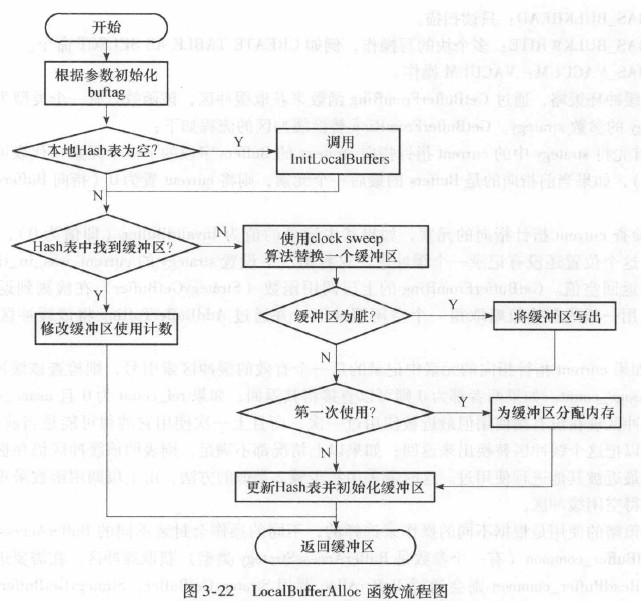
通过InitLocalBuffer来完成, 在使用时创建缓冲区。
缓冲区的获取主要通过调用LocalBufferAlloc函数来完成。
LocalBufferAlloc函数流程图如下所示:
3.3.4. IPC
IPC有多重实现方法, 包括文件、Socket、共享内存等。PostgreSQL中的IPC主要采用共享内存的方式来实现。
PG的IPC机制提供的功能:
- 进程和
Postermaster的通信机制 - 统一管理进程的相关变量和函数
- 提供了
SI message机制 - 有关清楚的函数
3.3.4.1 共享内存管理
在初始化过程中, 为共享内存创建了一个名为ShmemIndex的哈希索引。
static HTAB *ShmemIndex = NULL; /* primary index hashtable for shmem */

struct HTAB
{
	HASHHDR    *hctl;			/* => shared control information */
	HASHSEGMENT *dir;			/* directory of segment starts */
	HashValueFunc hash;			/* hash function */
	HashCompareFunc match;		/* key comparison function */
	HashCopyFunc keycopy;		/* key copying function */
	HashAllocFunc alloc;		/* memory allocator */
	MemoryContext hcxt;			/* memory context if default allocator used */
	char	   *tabname;		/* table name (for error messages) */
	bool		isshared;		/* true if table is in shared memory */
	bool		isfixed;		/* if true, don't enlarge */

	/* freezing a shared table isn't allowed, so we can keep state here */
	bool		frozen;			/* true = no more inserts allowed */

	/* We keep local copies of these fixed values to reduce contention */
	Size		keysize;		/* hash key length in bytes */
	long		ssize;			/* segment size --- must be power of 2 */
	int			sshift;			/* segment shift = log2(ssize) */
};
当试图为一个模块分配内存时,调用函数ShmemInitStruct,现在ShmemIndex索引中查找, 找不到再调用ShmemAlloc函数在内存中为其分配区域。
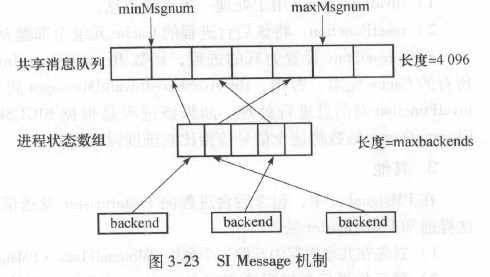
3.3.4.2 SI Message
PostgreSQL在共享内存中开辟了shmInvalBuffer记录系统中所发出的所有无效消息以及所有进程处理无消息的进度。
static SISeg *shmInvalBuffer;	/* pointer to the shared inval buffer */

typedef struct SISeg
{
	/*
	 * General state information
	 */
	int			minMsgNum;		/* oldest message still needed */
	int			maxMsgNum;		/* next message number to be assigned */
	int			nextThreshold;	/* # of messages to call SICleanupQueue */
	int			lastBackend;	/* index of last active procState entry, +1 */
	int			maxBackends;	/* size of procState array */

	slock_t		msgnumLock;		/* spinlock protecting maxMsgNum */

	/*
	 * Circular buffer holding shared-inval messages
	 */
	SharedInvalidationMessage buffer[MAXNUMMESSAGES];

	/*
	 * Per-backend state info.
	 *
	 * We declare procState as 1 entry because C wants a fixed-size array, but
	 * actually it is maxBackends entries long.
	 */
	ProcState	procState[1];	/* reflects the invalidation state */
} SISeg;
这里的SISeg.buffer采用了环形缓冲区结构。
ProcState结构记录了PID为procPid的进程读取无效消息的状态
typedef struct ProcState
{
	/* procPid is zero in an inactive ProcState array entry. */
	pid_t		procPid;		/* PID of backend, for signaling */
	PGPROC	   *proc;			/* PGPROC of backend */
	/* nextMsgNum is meaningless if procPid == 0 or resetState is true. */
	int			nextMsgNum;		/* next message number to read */
	bool		resetState;		/* backend needs to reset its state */
	bool		signaled;		/* backend has been sent catchup signal */
	bool		hasMessages;	/* backend has unread messages */

	/*
	 * Backend only sends invalidations, never receives them. This only makes
	 * sense for Startup process during recovery because it doesn't maintain a
	 * relcache, yet it fires inval messages to allow query backends to see
	 * schema changes.
	 */
	bool		sendOnly;		/* backend only sends, never receives */

	/*
	 * Next LocalTransactionId to use for each idle backend slot.  We keep
	 * this here because it is indexed by BackendId and it is convenient to
	 * copy the value to and from local memory when MyBackendId is set. It's
	 * meaningless in an active ProcState entry.
	 */
	LocalTransactionId nextLXID;
} ProcState;
SI Message机制示意图:
SendSharedInvalidMessages调用SIInsertDataEntries来完成无效消息的插入。